
 Deutsch
Behind the scenes / Black Forest
How the Black Forest Shaped My Astrophotography Journey
From my first night-sky experiments without a driver’s license to deep-sky projects under cold winter skies — the Black Forest played a major role in how I grew into astrophotography.
The Black Forest is where my astrophotography journey really began.
I got into photography in 2017 through my training as a photo and media technical assistant. What started as general photography quickly led me, almost by accident, toward the night sky.
One of the first things you learn in astrophotography is simple: dark skies matter. There is no real replacement for a sky with low light pollution. And for someone growing up near Freiburg, close to the southern Black Forest, that was a huge advantage.
I had reasonably dark skies right in front of my door — at least by Central European standards. That made it possible to experiment often, make mistakes, return again and again, and slowly understand what actually matters when photographing the night sky.
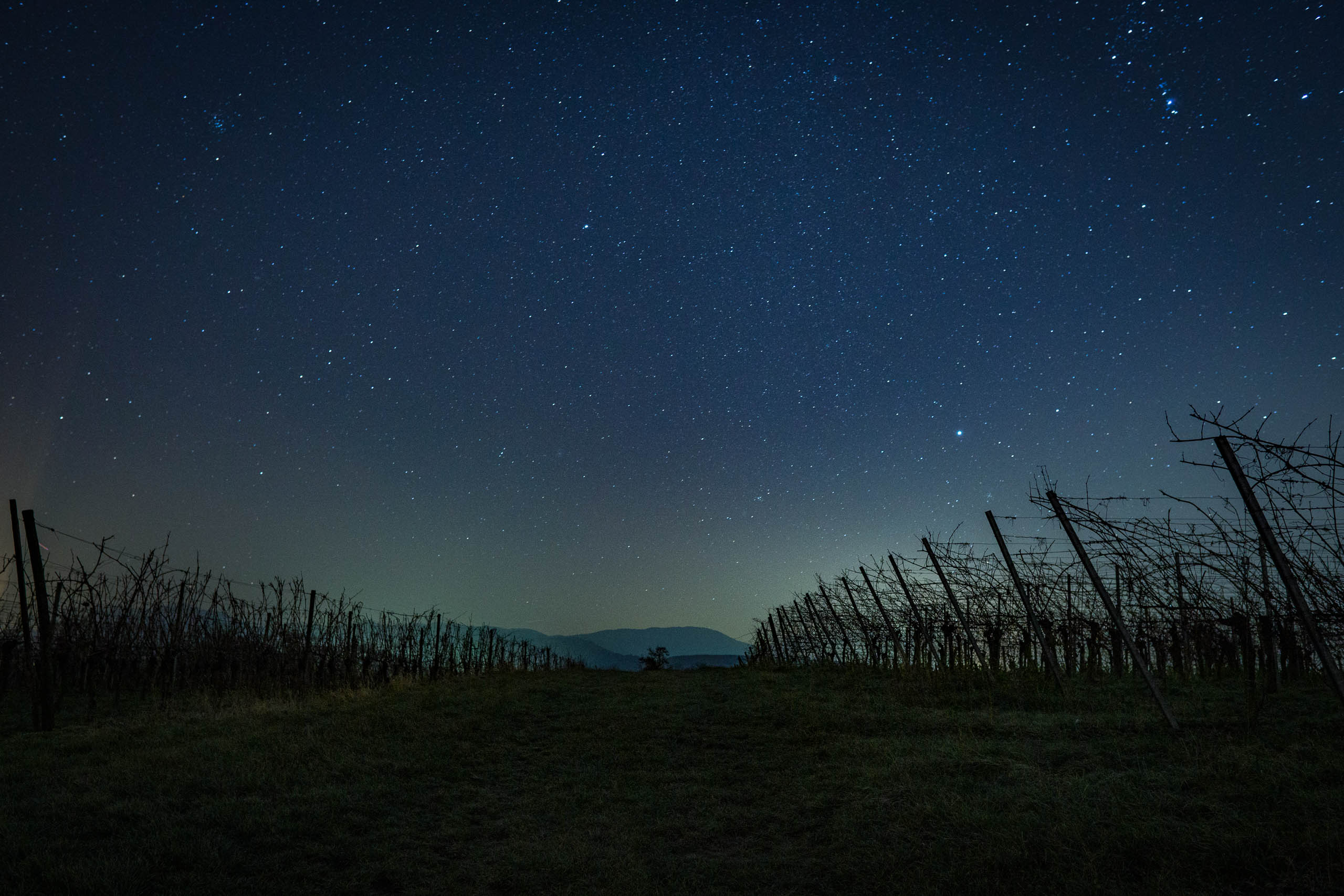
My first attempt at capturing the stars with the legendary Sony a6000 + Samyang 12mm f2
First attempts
Before I could even drive myself
When I started with astrophotography, I did not even have a driver’s license yet. That made reaching darker places much more complicated.
In the beginning, I depended on my parents to drive me up into the mountains at night. Most of the time, my father came with me, waited while I tried to capture my first night-sky images, and then drove me back home after an hour or so.
Sometimes I even used my bicycle and rode uphill for around half an hour just to get a little bit away from the brighter areas. I was not deep in the Black Forest yet, but it was enough to start learning.
Why it mattered
A local training ground for astrophotography
The Black Forest was not the darkest place in the world, but it gave me something just as important in the beginning: access, repetition and the chance to learn under real night-sky conditions.
Dark skies close to home
For Central Europe, the southern Black Forest offers surprisingly useful conditions for night-sky photography.
Easy access for testing
Being able to reach mountain locations within a short time made it possible to test ideas, equipment and techniques often.
High-altitude winter nights
Locations above 1000 meters often rise above fog and low clouds, creating clear skies while the valleys stay covered.
A path into deep-sky work
The region became the place where I tested telescopes, mounts and processing workflows for many early deep-sky projects.
More Freedom, More Nights Outside
Once I got my driver’s license, everything changed. I could take my mother’s car, pack my camera gear and drive into the Black Forest whenever the forecast looked promising.
That freedom made a huge difference. Suddenly, locations like the Feldberg area or Schauinsland became realistic options for regular night photography. I could go deeper into the mountains, get away from the brighter towns and spend more time experimenting under better skies.
Those nights were not always technically perfect, but they were important. I learned how much location, altitude, weather, humidity and light pollution affect the final image. I also learned that astrophotography is not only about camera settings — it is about planning, patience and being willing to fail repeatedly.
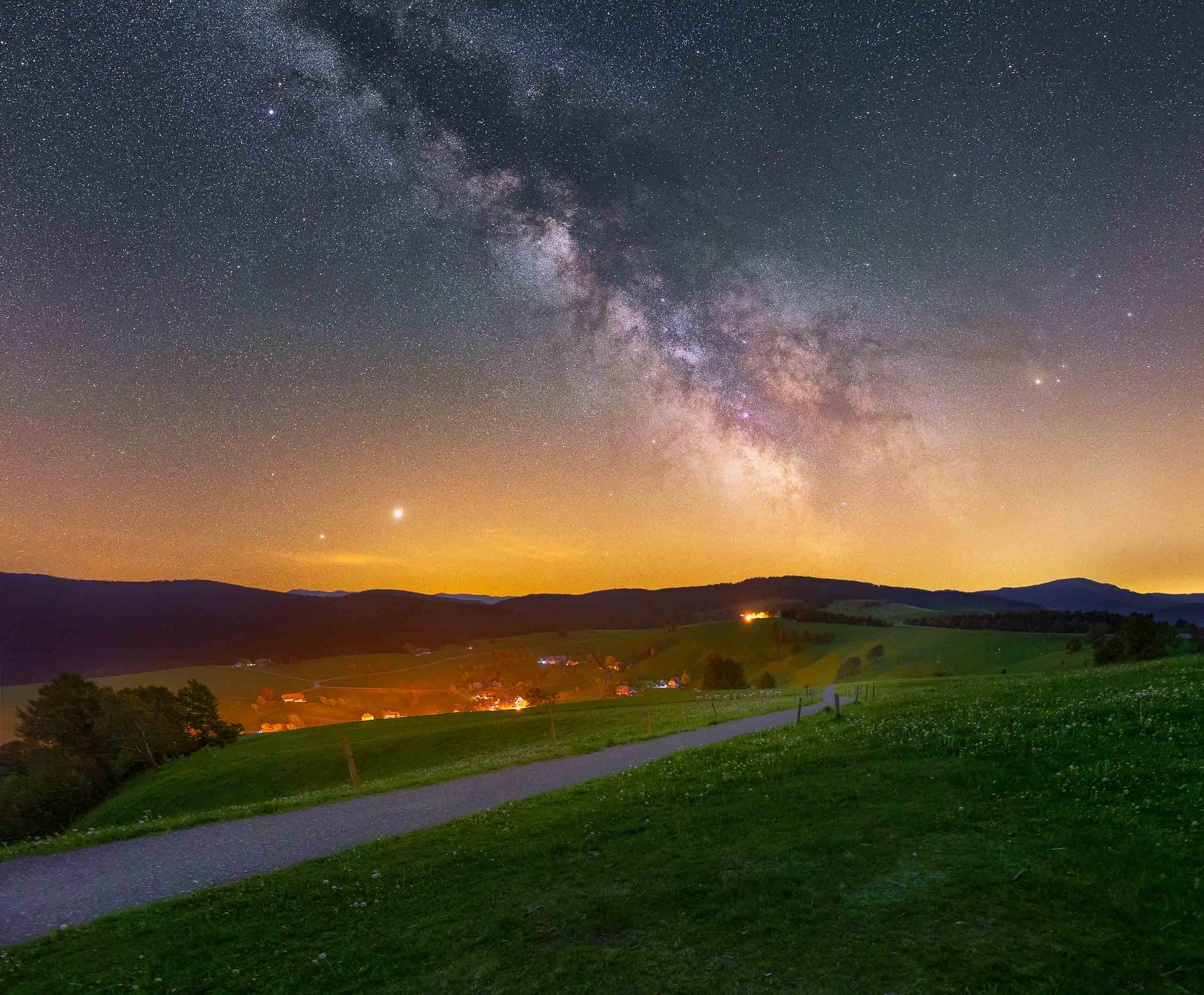
Image suggestion: an early Milky Way image, a camera setup in the Black Forest or a nightscape from the Feldberg or Schauinsland area.
Deep-sky beginnings
A new world beyond wide-angle nightscapes
For the first part of my journey, astrophotography mainly meant landscape work: a camera, a wide-angle lens, a tripod and the Milky Way above the horizon.
That changed when I met my friend Julian Shroff. He introduced me more seriously to deep-sky astrophotography and showed me that there was an entirely different side to the hobby — telescopes, mounts, long exposures, tracking, filters and a completely different way of thinking about the night sky.
Through him, I also became connected with Sternfreunde Breisgau e.V., an astronomy association in the Freiburg area. That environment gave me access to more knowledge, more experienced people and a much stronger connection to the astronomy community.
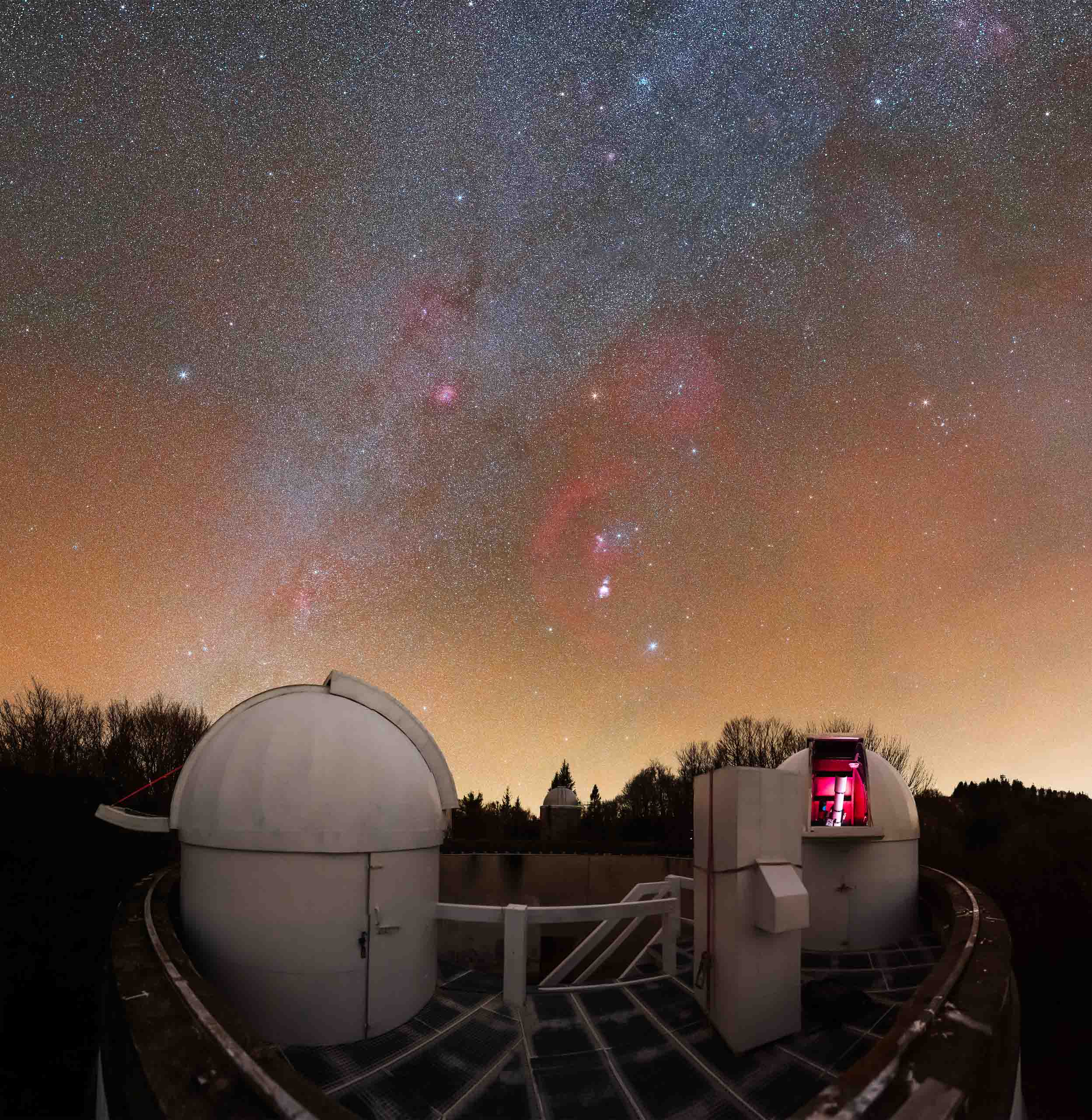
One of my first nights at the observatory from Sternfreunde Breisgau e.V.
From Freiburg to Namibia
One detail I still find fascinating is how far some of these local astronomy connections reach. Several people connected to the IAS, the International Amateur Observatory at Hakos in Namibia, came from the same astronomy community around Freiburg and the Black Forest.
Knowing some of these people personally gave me a much deeper appreciation for how connected the amateur astronomy world can be.
That connection became even more meaningful later, when I traveled to Namibia myself and experienced those southern skies in person.
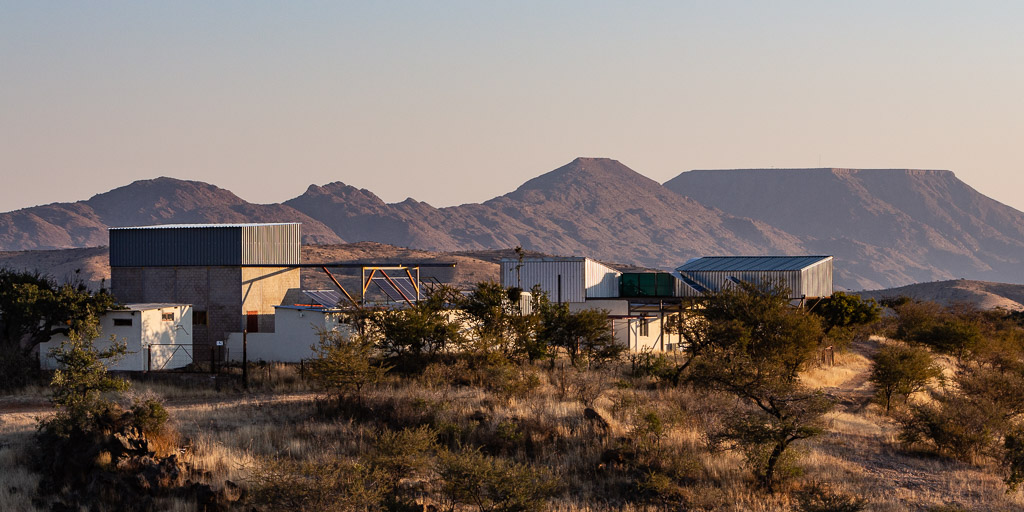
IAS Observatory Hakos (1834 m) Photo: Martin Junius 2018
When the Black Forest Started to Feel Too Familiar
As I gained more experience, I also started traveling to other locations: the Alps, La Palma and later Namibia. Those places showed me very clearly how much a truly dark sky and a dramatic landscape can change an image.
The Black Forest is good — especially for Central Europe — but it is still surrounded by light pollution. Cities and regions like Freiburg, Basel, the Rhine Valley, parts of Switzerland and nearby areas in France all affect the sky to some degree.
For landscape astrophotography, I also started to feel limited creatively. The Black Forest is beautiful, especially during the day, but at night many compositions can start to feel similar after you have photographed the region many times.
At some point, I slowly shifted more of my focus toward deep-sky photography. Instead of searching for new foregrounds, I began spending more nights testing equipment, mounts, telescopes and processing techniques under the dark mountain skies of the Black Forest.
The Black Forest was not always the perfect location — but it was the perfect place to learn.
It gave me enough darkness, enough access and enough clear nights to build experience over many years.
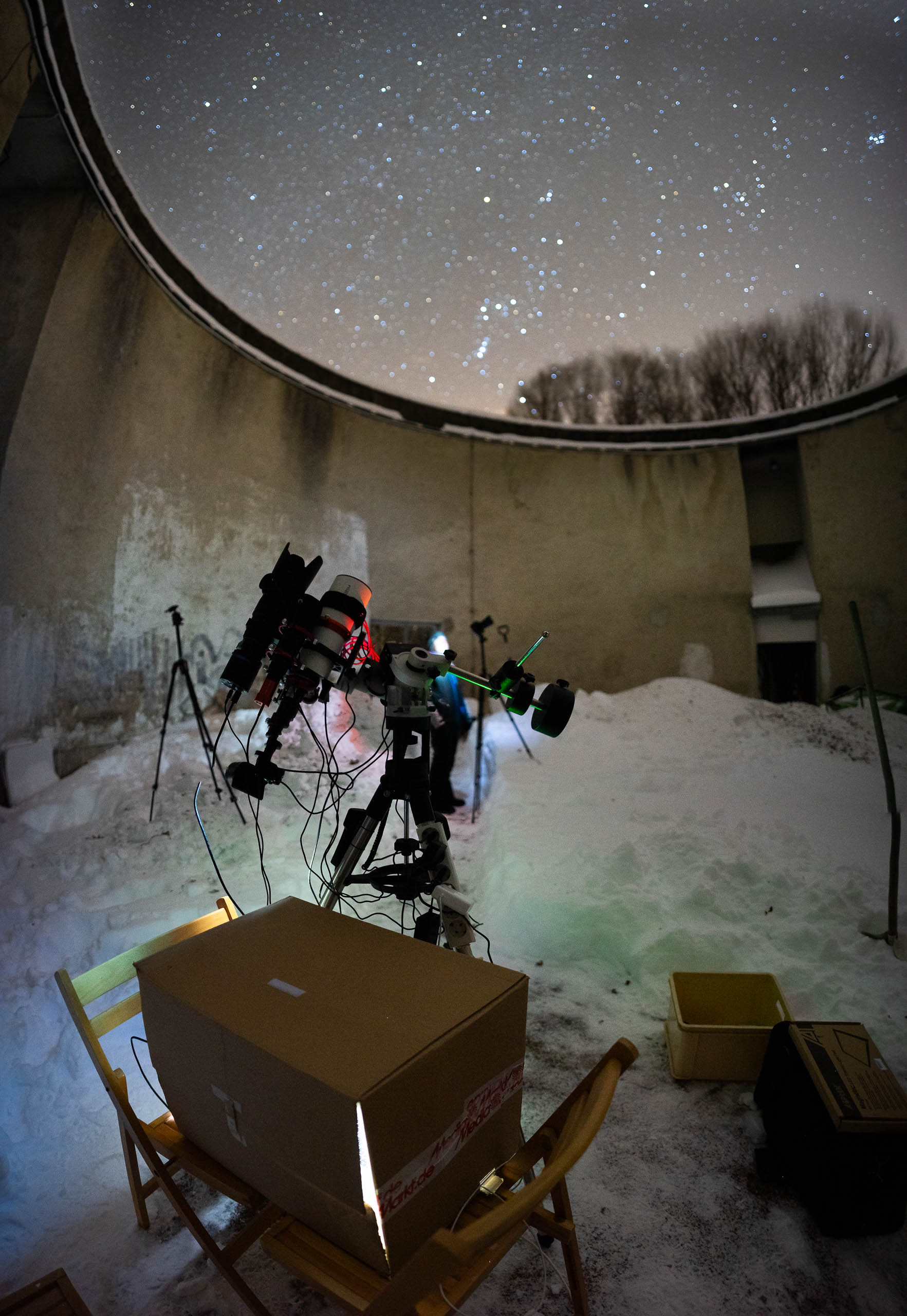
Behing the scenes from one of the winter nights at the observatory.
Deep-sky reality
Cold nights and technical frustration
During the years when I focused mostly on deep-sky astrophotography, the Black Forest became my testing ground. I drove up into the mountains, froze through winter nights and tried new telescopes, mounts, cameras and techniques.
It was exciting, but also extremely frustrating at times. After waiting for a clear night for weeks, nothing feels worse than losing it to a technical problem — a mount that does not behave, a guiding issue, a cable problem or software that refuses to cooperate.
There were many nights where I seriously thought about quitting the hobby. But I kept going. Looking back, those frustrating nights were part of the process. They taught me patience, problem solving and how much preparation matters in astrophotography.
Why the Black Forest Still Matters Today
Today, I photograph much more broadly again. I still do deep-sky work, but I also travel more for nightscape photography, spend more time in the Alps and plan longer road trips or short flights to locations with stronger landscapes and darker skies.
Still, the Black Forest remains important to me. For deep-sky photography especially, it is still an excellent region. Many locations in the southern Black Forest are above 1000 meters, with the Feldberg reaching almost 1500 meters. That altitude can make a huge difference.
In winter, inversion weather conditions often create one of the biggest advantages of the region. The valleys can be covered in fog while the higher mountains stay perfectly clear. When that happens, the fog also blocks a lot of the light pollution from the Rhine Valley, Freiburg, Switzerland and surrounding towns.
Under the right conditions, the sky can become dramatically better than it would normally be. Sometimes the difference feels like jumping an entire level in sky quality. For someone who can reach those locations in about an hour, that is incredibly valuable.
Above the fog
Some of the best Black Forest nights happen above the clouds
When the valleys disappear below a layer of fog and the mountains stay clear, the Black Forest can offer surprisingly dark and stable skies for deep-sky work.
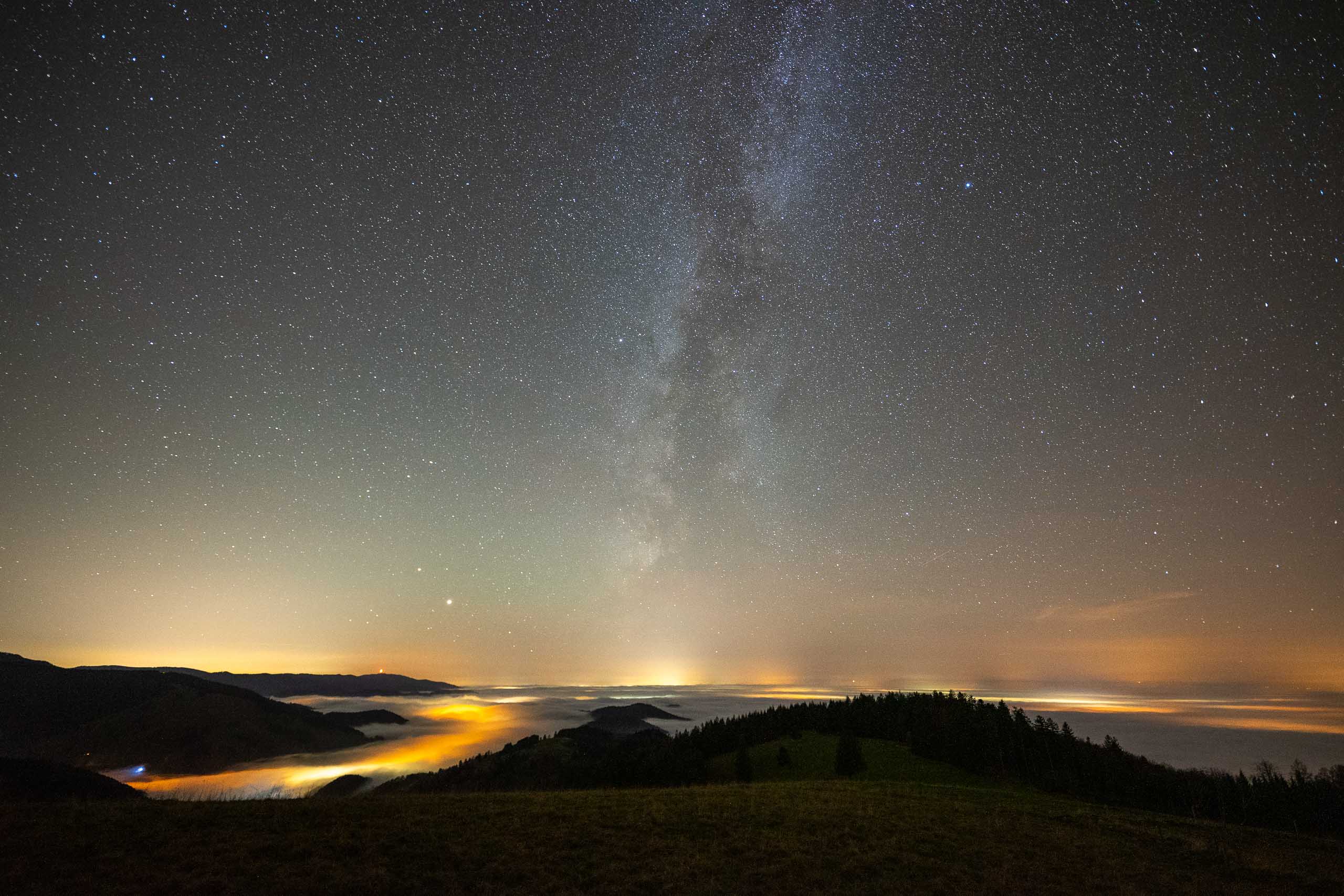
Above the clouds/fog in the black forest. Looking towards the setting Milky Way core in the west.
From Local Hills to a Bigger Astrophotography Journey
The Black Forest shaped my astrophotography journey because it gave me a place to start — and a place to return to.
It was where I made my first attempts, where I learned how important dark skies really are, where I discovered the limits of landscape astrophotography close to home and where I built much of my deep-sky experience.
It also taught me that growth often comes from repetition. Driving out again and again, failing again and again, freezing through clear winter nights and still coming back the next time — that is how much of my astrophotography foundation was built.
Today, I travel more and seek out places with darker skies and stronger landscapes. But the Black Forest remains part of my story. It is still one of the most useful places I have close to home, and it will always be the region where my journey under the night sky truly began.

Explore the images
See my astrophotography work from the Black Forest
Browse selected nightscape and deep-sky images captured close to home under the dark skies of the Black Forest.
